
Petty cash
Petty cash for small business: how to make it balance every night
Why petty cash almost never balances, four rules that prevent most shortages, and how to apply them with a notebook or an app.
· 4 min read
It’s 7 p.m. You count the drawer and you’re 6,200 DA short. Nobody stole anything. The next day it all comes out: a taxi to deliver some panels, a bag of screws paid for in a rush, and an employee who “was going to write it down”.
That’s almost always how it goes. A cash shortage rarely comes from theft. It comes from an expense made too fast and written down too late, or never.
Why petty cash doesn’t balance
The same three causes show up in almost every small business.
The expense written down “later”. Later means the evening, when nobody remembers whether the diesel was 3,500 or 4,200.
Personal money mixed with the cash box. The owner pays 2,000 DA out of pocket, pays himself back from the drawer three days later, and tells no one.
Cash taken out “for the day”. An employee takes 10,000 DA for a purchase and brings the change back that evening… or the next day, or the week after.
None of these problems go away by counting more often. They go away when you change the way money leaves the box.
Four simple rules
1. One register, one person in charge
If three people dip into the same drawer, nobody is responsible for the gap. Give every register a person’s name. If two employees handle cash out in the field, that’s two registers.
2. Nothing leaves without a line
Amount, who, why. At the moment the money leaves, not in the evening. A line takes ten seconds. Rebuilding a whole day takes half an hour and usually ends with “fine, put it under miscellaneous”.
3. A receipt, or a sentence
A receipt is ideal. But a taxi doesn’t always give one. In that case, one sentence will do: “Taxi Bab Ezzouar → workshop, panel delivery, no receipt”. What matters is that someone can understand the expense three months from now.
4. Count at a set time, and record the difference even when it’s zero
Every evening, or every Saturday, depending on your volume. Write down what should be there, what is there, and the difference. A difference of 0 recorded every day for a month is information too: you know the method holds.
With a notebook
If you work alone, or two of you share the same shop, a well-kept notebook does the job just fine. Draw these columns:
| Date | Who | In | Out | Reason | Balance | Receipt |
|---|---|---|---|---|---|---|
| 04/11 | Yacine | 3,500 | Van fill-up | 41,700 | ✓ | |
| 04/11 | Nadia | 1,200 | Taxi, delivery | 40,500 | no | |
| 05/11 | Karim | 20,000 | Bank withdrawal | 60,500 | ✓ |
The balance is worked out again on every line. In the evening, you compare the last box with the drawer.
A notebook has two limits. It stays at the office, while expenses happen outside. And it doesn’t add anything up for you: monthly totals by category have to be redone by hand.
When the notebook stops being enough
Usually that moment comes when an employee spends money far from you: on a job site, on a delivery run, at a supplier’s. They can’t write in your notebook. So they call you, or send a photo of the receipt on WhatsApp, and you’re the one copying it all out in the evening.
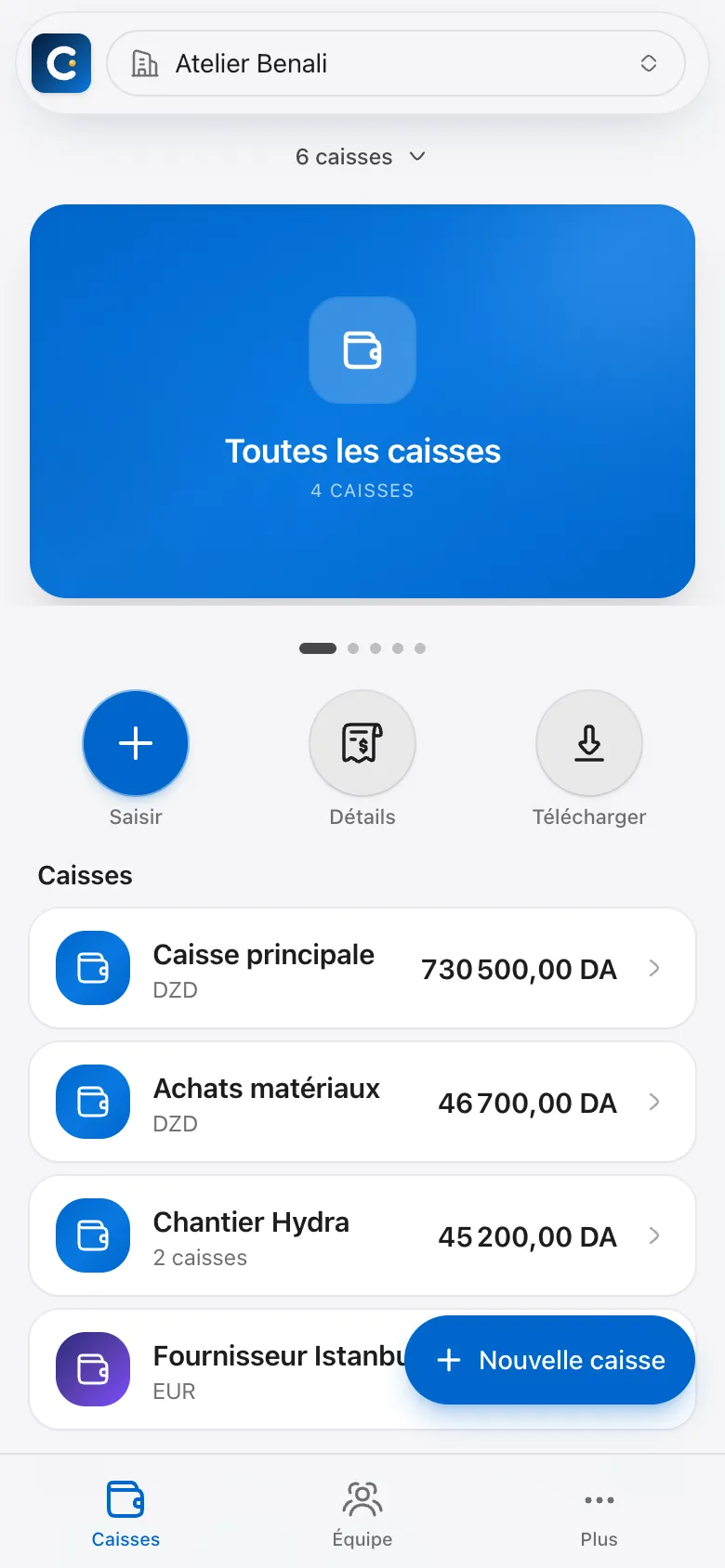
That’s exactly the situation we built MyCaisse for. Every register has its own balance, and every employee records expenses from their phone at the moment they pay, with a photo of the receipt.
In the evening, you no longer have to rebuild the day: you read through it. You can see who spent what, from which register, with the receipt attached.
For registers with a real cash drawer, you can also turn on cash close-out: you open the day with an opening float, enter the counted amount in the evening, and the app shows the discrepancy against the expected amount. Close-outs stay in the history, with the name of the person who did the count.
Where to start
You don’t need to change everything this week. Do three things:
- Give every register a person in charge, tonight.
- Count it and write down the starting amount.
- For seven days, apply the “nothing leaves without a line” rule, on paper or on a phone.
At the end of the week, compare the shortages with last month’s. You’ll know whether the method is enough on its own or whether you need a tool.
If you want to see what a well-kept register looks like before you decide, open our demo account. It’s a fictional aluminium joinery business, Atelier Benali, with its registers, its three employees and a month of entries. No sign-up, and you can touch everything.